
Breakfast rush tells the truth about a kitchen faster than any showroom photo ever will. If two people are reaching for lunchboxes, one child is parked at the counter doing homework, and dinner prep still needs to happen, the best kitchen layout for families is the one that keeps traffic moving without turning every meal into a bottleneck.
For most family homes, layout matters more than finishes. Cabinet color can change the look, but layout decides whether the room feels calm or chaotic. A family kitchen needs to support cooking, storage, conversation, supervision, and cleanup – often all at the same time. That means the right answer is rarely about following trends. It is about choosing a plan that fits how your household actually lives.
What makes the best kitchen layout for families?
A family-friendly kitchen does three things well. It creates clear movement paths, gives people enough room to share the space, and separates busy zones so every task does not happen on top of another.
That sounds simple, but it changes a lot of design decisions. A kitchen that works for a couple who mostly cooks at night may not work for a family with young kids, school bags, packed lunches, and constant snacks. The best kitchen layout for families usually includes generous prep space, practical storage near where items are used, and seating that does not block the main work area.
Good family layouts also account for visibility. Parents often want to cook while keeping an eye on children, talking with guests, or helping with schoolwork. Open sightlines can make a kitchen feel more connected and more useful, especially in homes where the kitchen doubles as a social hub.
The layouts that tend to work best
There is no single perfect plan for every household, but some layouts consistently perform better in family homes than others.
L-shaped kitchens
An L-shaped kitchen is one of the most flexible options for families because it opens up floor space and keeps the main work area compact. This layout places cabinetry and appliances along two adjoining walls, which often leaves room for a dining table or island if the space allows.
For families, the big advantage is circulation. People can move around the room without constantly crossing directly through the cook zone. It also suits open-plan living well, which helps with visibility and makes everyday supervision easier.
The trade-off is that storage and bench space depend heavily on room size. In a smaller footprint, an L-shape can feel efficient. In a larger room, it may spread work zones too far apart unless an island helps bring everything together.
U-shaped kitchens
A U-shaped kitchen offers strong function because it surrounds the user with storage, appliances, and prep space on three sides. For larger families or serious home cooks, this can be very effective. There is usually plenty of countertop area, and the layout naturally supports the classic sink, cooktop, and refrigerator triangle.
This setup works especially well when one or two people are doing the cooking and cleanup while others stay just outside the main work area. If planned well, it creates a dedicated workspace that feels organized rather than exposed.
The downside is that a U-shaped kitchen can feel closed off if the room is narrow or dark. It also needs careful measurement. If the distance between runs is too tight, multiple people will struggle to pass each other. If it is too wide, the space becomes less efficient.
Galley kitchens
Galley kitchens can work surprisingly well for families in compact homes because they make efficient use of limited space. With cabinetry on two parallel walls, everything is within easy reach, and workflow can be excellent.
But this layout is less forgiving when the kitchen is a shared zone. If the walkway is narrow, a galley can feel crowded fast, especially during busy mornings. It is usually better for homes where the kitchen is primarily a cooking space rather than a gathering place. If a galley layout is the right fit, smart storage and strict attention to aisle width matter more than ever.
Island kitchens and open-plan layouts
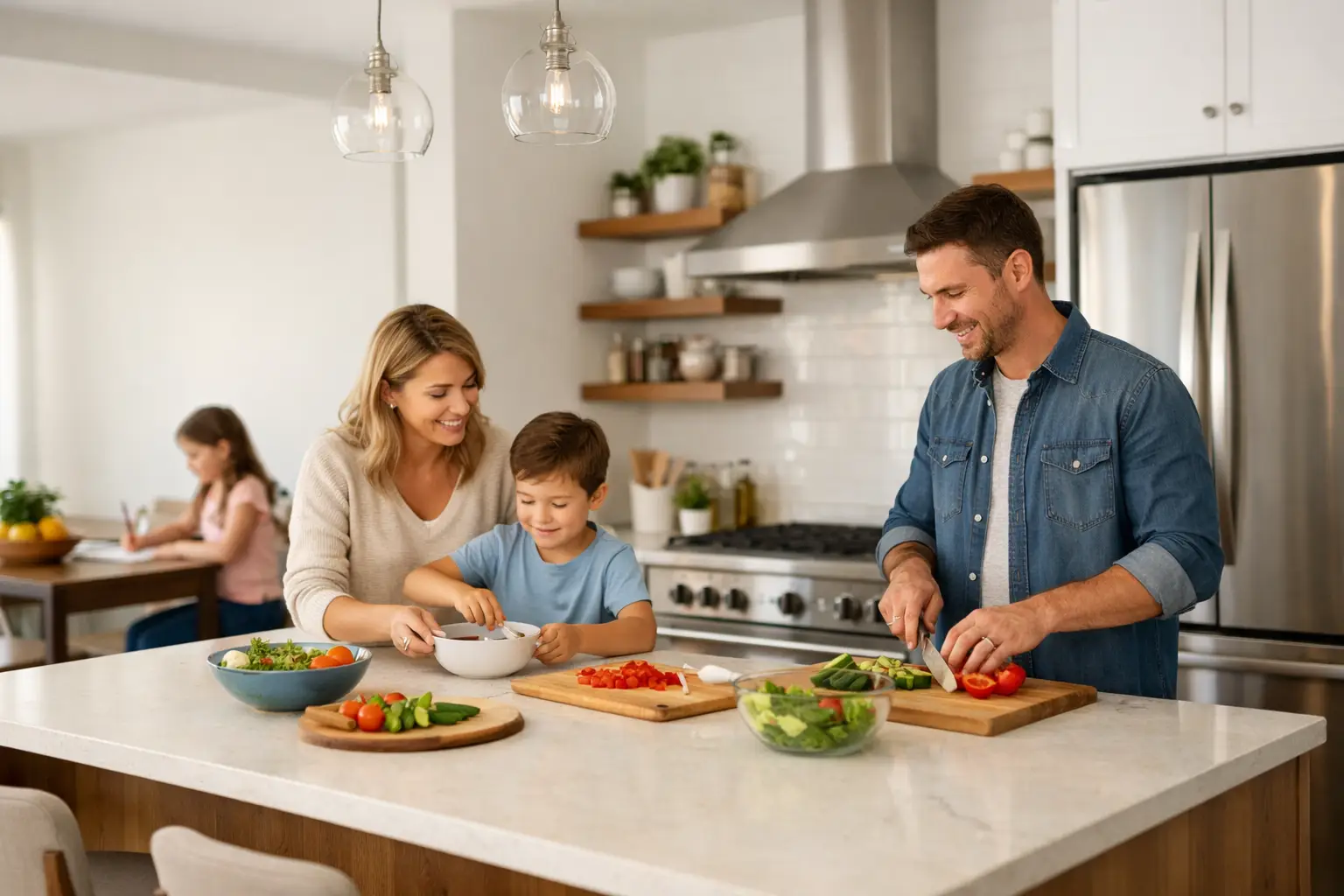
For many modern homes, the most practical answer is an L-shaped or U-shaped kitchen with an island. This is often the strongest layout for family life because it combines work efficiency with social function. The island can provide extra prep space, casual seating, hidden storage, and a spot for kids to sit nearby without standing underfoot.
That said, an island is only helpful when the room is large enough. In a tight kitchen, adding one can create more congestion instead of less. The best island kitchens leave enough clearance around all sides so doors, drawers, and people can move comfortably.
Why zoning matters more than shape alone
Families do not use kitchens for one purpose. They use them for many small tasks happening at once. That is why zoning often matters more than the layout label.
A well-zoned kitchen might include a prep zone near the sink, a cooking zone around the range, a snack zone where kids can reach cups and fruit, and a cleanup zone that does not interrupt meal prep. In larger kitchens, a beverage station or homework perch can make the room feel far more functional without adding square footage.
This approach reduces conflict. Instead of everyone competing for the same stretch of counter, each task has a natural home. That is often the difference between a kitchen that looks good and one that genuinely supports family life.
Storage decisions that improve family use
The best family kitchen layout will always fall short if storage is poorly planned. Families tend to need more than standard cabinetry allows for – lunch containers, water bottles, small appliances, bulk groceries, kids’ dishes, and the daily overflow that comes with a busy household.
Deep drawers usually outperform lower cabinets because they make items easier to see and reach. Pantry storage helps keep groceries organized and prevents the main kitchen from feeling cluttered. It also makes sense to store everyday items close to where they are used. Plates near the dishwasher, breakfast supplies near the toaster, and school lunch items grouped together can save a surprising amount of time.
If children are part of the household, accessible storage can be a real advantage. Giving them a low drawer or cabinet for snacks, cups, or bowls can reduce traffic through the main prep zone and encourage independence at the same time.
Seating, safety, and everyday comfort
Seating is often where family kitchens either shine or disappoint. Bench seating at an island can be useful for quick meals, homework, or conversation, but it should not come at the expense of circulation. If stools block walkways or back into appliances, they will become a frustration quickly.
Safety also deserves more attention than it usually gets in the early planning stage. Families with younger children may want more distance between seating and the cooktop, soft-close drawers, rounded countertop corners, and enough room to move without bumping into hot surfaces. Even in households with older kids, a layout that reduces crowding around the stove and oven makes everyday use easier.
Comfort matters too. A kitchen that is technically efficient but feels cramped, noisy, or overexposed will wear on people over time. Good design is not just about fitting everything in. It is about making daily routines feel smoother.
How to choose the right layout for your home
The best starting point is not the style you like online. It is the pattern of your day. Think about where bags get dropped, where kids naturally sit, how many people cook at once, and whether your kitchen needs to be a social space, a focused workspace, or both.
Room shape will always influence the answer. A narrow footprint may favor a galley or compact U-shape. A wider open-plan area may suit an L-shape with an island. Structural walls, windows, and plumbing locations can also affect what is realistic without pushing the renovation budget too far.
This is where experienced planning makes a real difference. A good renovation team looks beyond cabinet placement and considers flow, storage, lighting, appliance clearances, and how the kitchen connects to the rest of the home. For homeowners who want practical improvements without a drawn-out process, that kind of upfront clarity helps avoid expensive layout mistakes later. Companies like DY Construction Group often see the same issue again and again – homeowners focus on finishes first, when the real long-term value comes from getting the layout right.
The layout that usually wins
If there is one layout that tends to serve the widest range of families well, it is an open L-shaped kitchen with an island, provided the room has enough space. It supports movement, creates clear zones, allows seating, and keeps the kitchen connected to the rest of the home.
But that does not make it the right answer for every house. Some families benefit more from a hard-working U-shape with more storage. Others need a compact galley that uses every inch efficiently. The best choice depends on your space, your routines, and how you want the kitchen to function five years from now, not just on move-in day.
A family kitchen earns its value in ordinary moments – rushed breakfasts, late dinners, lunch packing, quiet chats at the counter. When the layout supports those moments well, the whole home feels easier to live in.