

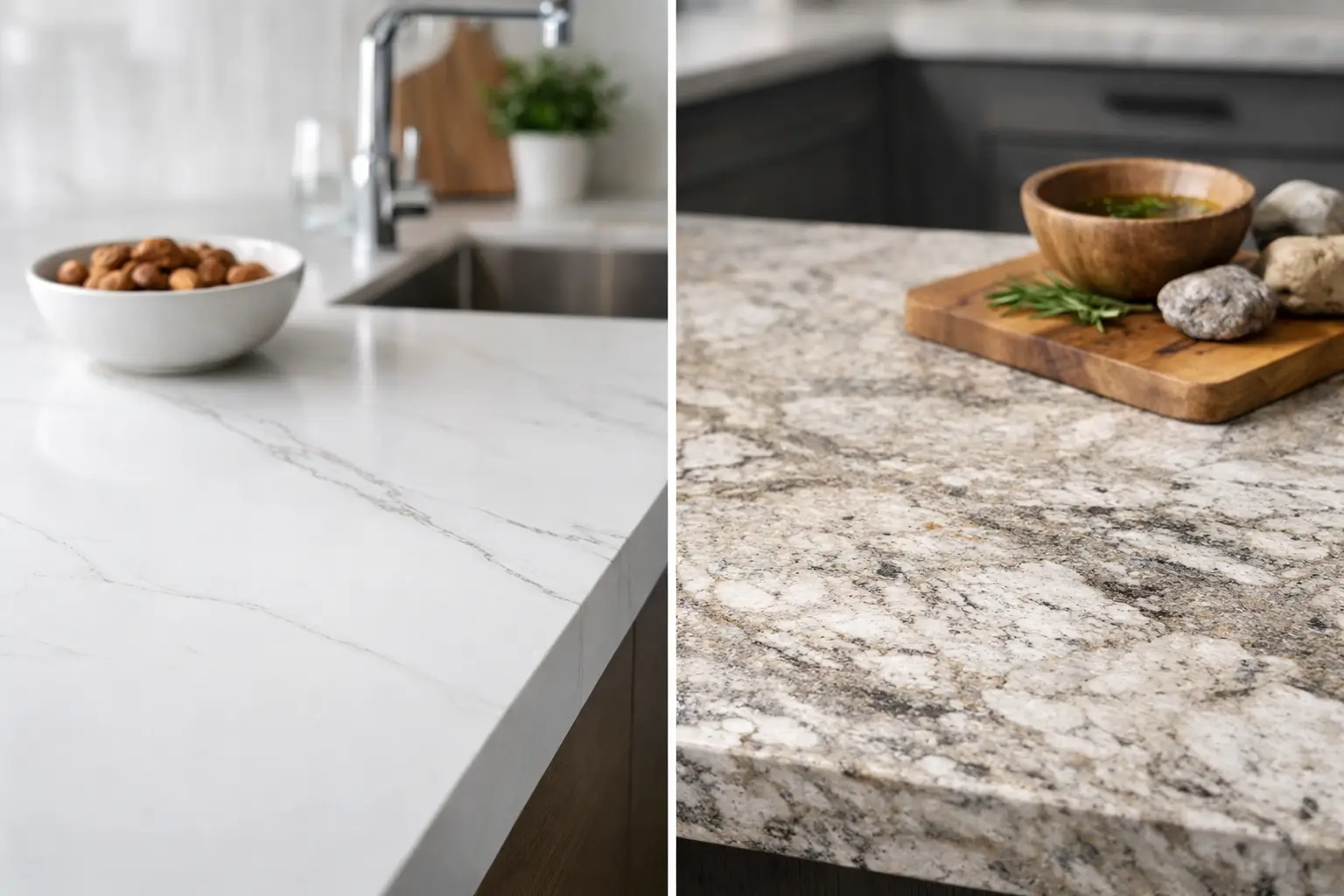
A kitchen countertop has to handle far more than a good first impression. It is where hot pans land, school lunches are packed, groceries are dropped, and family life happens every day. When comparing porcelain versus natural stone benchtops, the right choice comes down to how you use your kitchen, the look you want, and how much ongoing care feels realistic for your household.
Both materials can create a high-end kitchen. They are also very different products with different installation requirements, strengths, and compromises. A clear comparison before finalizing your design can prevent expensive changes later in the renovation.
Porcelain versus natural stone benchtops: the main difference
Porcelain is a manufactured surface made from refined clay, minerals, and pigments that are fired at extremely high temperatures. It is available in large, slim slabs and can replicate the movement of marble, the depth of natural stone, concrete, or more contemporary finishes. Its appearance is consistent from slab to slab, which makes planning a coordinated kitchen easier.
Natural stone is quarried from the earth, then cut and finished into slabs. Marble, granite, quartzite, and travertine each have their own characteristics. No two slabs are identical. Veining, mineral deposits, color shifts, and small natural variations are part of the appeal, particularly for homeowners who want their kitchen to feel individual rather than uniform.
The key distinction is predictability versus natural variation. Porcelain gives you more control over the final pattern and performance. Stone gives you depth and character that cannot be exactly copied, but it asks you to accept and care for a naturally variable material.
Everyday durability in a busy kitchen
Heat, stains, and scratches
Porcelain performs very well in high-use kitchens. It is non-porous, so everyday spills from coffee, cooking oil, tomato sauce, and wine are less likely to leave a lasting mark. It is also highly resistant to heat and UV exposure, making it a practical option for kitchens with strong natural light or outdoor entertaining areas.
That does not mean porcelain is indestructible. While its surface is hard and scratch-resistant, the edges can chip if struck sharply with a heavy pot or appliance. This matters most around exposed corners, waterfall ends, and undermount sink cutouts. A careful fabricator, suitable edge detail, and sensible use all help reduce that risk.
Natural stone varies widely. Granite and quartzite are generally strong choices for active family kitchens, with good heat resistance and durability. Marble is softer and more reactive. It can scratch, etch, or dull when exposed to acidic foods such as lemon juice, vinegar, or wine. Some homeowners love the gentle patina that develops over time. Others find it frustrating, especially in a kitchen that sees constant cooking and entertaining.
Moisture and sealing
Porcelain does not usually require sealing. That makes it appealing for homeowners who want a lower-maintenance surface without worrying about whether a spill was wiped up quickly enough.
Most natural stone needs to be sealed when installed and resealed periodically, depending on the stone, finish, and how heavily the kitchen is used. Sealing does not make stone completely stain-proof, but it gives you more time to clean up spills before they penetrate the surface. A reliable installer should explain the care requirements for the exact slab you select rather than treating every type of stone the same.
Appearance: controlled design or one-of-a-kind character
Porcelain has come a long way from its early, flat-looking finishes. Quality slabs can create a convincing marble-inspired look, including bold veining and soft movement. Because the pattern can be selected in advance, porcelain works well in clean, modern kitchens where a consistent visual result matters. It can also be continued up the wall as a backsplash for a streamlined finish.
There is still a difference between a printed or engineered pattern and natural geological movement. Natural stone has variation through the body of the slab, with depth that changes under different light. A dramatic quartzite or marble slab can become the defining feature of a kitchen, especially on a large island.
The best approach is to view full slabs in person. A small sample cannot show how veining will run across a long countertop, around a cooktop, or down a waterfall panel. For natural stone, slab selection is particularly important. For porcelain, ask to see the exact finish and pattern direction, since some designs may repeat more noticeably across a large surface.
Installation details matter as much as material choice
A beautiful slab can still disappoint if the fabrication and installation details are not properly planned. Porcelain is commonly thinner than natural stone and requires careful handling during cutting, transport, and fitting. Its edge profile may be mitered to create the appearance of a thicker countertop, which takes precision and can affect the overall cost.
Natural stone is heavier and often thicker, so cabinet strength, access into the home, and support for large overhangs should all be considered. An island designed for stool seating may need hidden steel support or brackets, particularly with a substantial stone top.
Sink and cooktop details also deserve attention. An undermount sink offers a clean look with either material, but the exposed edge around the cutout needs skilled finishing. If you are using a natural stone with pronounced veining, the fabricator should discuss where seams will fall and how the pattern will align. These are the details that make a finished kitchen feel deliberate rather than pieced together.
Cost: look beyond the price per square foot
There is no universal rule that porcelain is cheaper than natural stone or vice versa. Price depends on the selected material, slab size, thickness, edge treatment, cutouts, transportation, fabrication complexity, and installation access. A simple porcelain countertop may be cost-effective, while a large-format porcelain island with mitered edges and full-height backsplash can be a premium installation.
Natural stone pricing also has a broad range. Some granites can be comparatively accessible, while premium quartzite and highly sought-after marble can carry a significant price tag. The amount of waste created by your layout, the need for matching pieces, and the complexity of the vein direction can also affect the final quote.
For a more accurate budget, compare complete installed prices rather than focusing only on slab cost. Your quote should make clear what is included: measuring, templating, fabrication, sink and cooktop cutouts, edge work, installation, sealing where needed, and any required supports. Clear scope helps avoid surprises once cabinets are already in place.
Which countertop suits your household?
Porcelain is often the better fit when you want a refined look with minimal maintenance. It suits busy families, enthusiastic home cooks, and homeowners who prefer not to think about sealing or reacting quickly to acidic spills. It is also a strong option when you want a light-colored surface near windows or an outdoor kitchen that receives regular sun.
Natural stone is worth considering when authenticity is central to your design. If the movement and individuality of real marble, granite, or quartzite is what you respond to, no manufactured alternative will feel exactly the same. Granite and quartzite can offer a practical middle ground for households that want natural material with stronger day-to-day resilience. Marble is best chosen with open eyes: it is beautiful, but it will show its life.
Your kitchen style matters too. A crisp contemporary kitchen may benefit from the controlled pattern and thin-profile possibilities of porcelain. A warmer, more layered kitchen can be elevated by the texture and irregularity of natural stone. Neither choice is automatically better. The right material is the one that supports your design while fitting your real routine.
Questions to settle before making a final selection
Before ordering either surface, think through how the countertop will be used after the renovation is complete. Will children regularly eat or do homework at the island? Do you cook with citrus, wine, and oils often? Are you comfortable with a surface that develops a patina? Do you want bold veining to be a focal point, or would you rather keep the background quieter?
It also helps to decide early whether you want a standard backsplash, a full-height slab backsplash, a waterfall end, or a thick-looking edge. These choices affect material quantities, fabrication time, and the support your cabinetry may need. Addressing them during design is far simpler than changing direction after measurements have been taken.
A well-planned kitchen is not about choosing the most expensive slab in the showroom. It is about selecting a surface that looks right in your home, performs well for your household, and is installed with the care it deserves. Take samples into your space, look at them in morning and evening light, and choose the option you will be comfortable living with long after the renovation is complete.